

The Princes Islands Of Istanbul
The Princes Islands Of Istanbul
Adalar
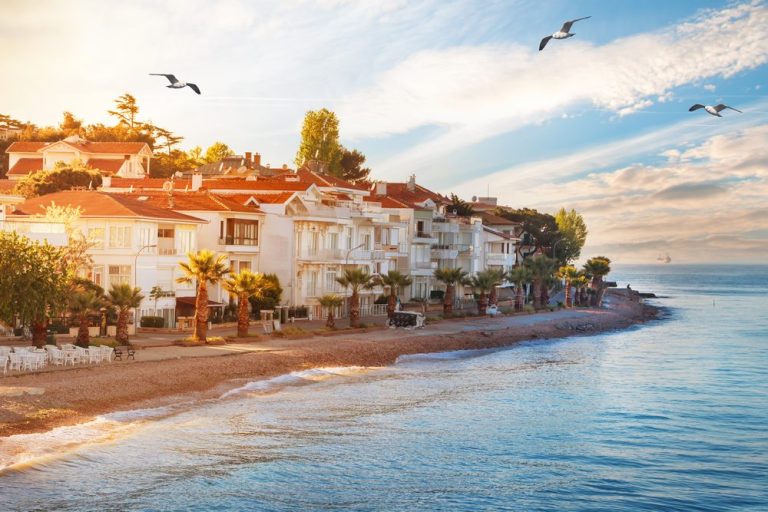
The stunning archipelago of Princes’ Islands, off the coast of Istanbul in the Sea of Marmara, are the perfect get-away destinations for residents of one of the busiest cities in the world, Istanbul. Just a short ferry ride from both the Asian and European coasts of the historic city, the islands provide a rare insight into a multicultural society in modern Turkey and are highly reminiscent of a life that once existed during the Ottoman Empire.
The collection of nine islands, four larger islands and five smaller, are completely closed off to modern day traffic. Motorised vehicles are prohibited in order to preserve the environment and prevent pollution, which gives the destinations even more of a feel of the days of yonder.

The main mode of transport, certainly on the larger islands is by horse and cart, which act as a taxi service or offer sightseeing tours. Otherwise, these picturesque spots of land can only be explored by foot or bicycle, offering a popular outdoorsy day trip from Istanbul, filled with culture, history and incredible views. Prior to the 1950s, the islands were home to the many of Turkey’s significant communities of ethnic minority. Today, their legacy is of cultural rather than demographic importance as they have long attracted Turkish residents and visitors. Popular with international visitors too, the islands create the perfect opportunity to escape the sight-seeing trail of the historic city, and in the winter time, a good excuse to experience, in some cases, a very deserted island.
History
These impressive islands became named the Princes’ Islands during the Byzantine period, when princes, empresses and other royalty were exiled on the islands. Later members of the Ottoman sultans family were exiled there too, taken by the Ottoman fleet during the siege of Constantinople in 1453. All over the archipelago, convents, churches and mansions provide a historical insight into the lives of the exiled and architecture of the ages has been retained. But the islands have been home to tragedy, scandal and contentment among the hundreds of historical stories of exile and its differing cultures over the years have made the islands an incredibly interesting place to explore.
During the nineteenth century, the islands became a popular resort for Istanbul’s wealthy and Victorian-era cottages and houses are still preserved on the largest island, Büyükada. From the early 1900s, the islands became home to some 10,250 Greeks and only 670 Turks. Greek Orthodox buildings can be found all over the collection of islands, including the oldest Greek seminary in Turkey, though many are in disrepair. However, with the healthy influx of wealth Turkish jetsetters in recent decades, the islands have become more and more ethnically Turkish in character.
Büyükada
With a population of 7000 and its area covering 5.46 km squared, Büyükada is the largest of the nine islands and the most popular with day trippers from Istanbul. The island is made of two peaks, both offering stunning vista views. Hristos, the hill closest to the ferry landing, is topped by a former Greek Orphanage, a huge wooden building that is now sadly in decay. The valley between the two peaks, contains the church and monastery of Ayios Nikolaos and the former and now abandoned fairground, Luna Park. Taking one of the horse-drawn carriage tours of the island will lead to this point where one can take the easy climb up to Ayia Yorgi, a tiny church with a café which serves wine, chips and sausage sandwiches, said to be an essential part of the Ayia Yorgi experience.

The island has many historic churches, monasteries and mansions that tourists can visit. A convent, built by Byzantine Emperor Justin II, was the place of exile for the Byzantine empresses Irene, Euphrosyne, Theophany, Zoe and Anna Dalassena. There are several historical buildings, which are incredibly popular, such as the Ayia Yorgi Church and Monastery which dates back to the 6th century and the Ayios Dimitrios Church. The Hamidiye Mosque, built by Abdul Hamid II is also an interesting contrast to what the island has to offer.
It is the mansions, however, that appear to attract the attention of visitors. Büyükada even has a designated historic mansion centre. These grand and majestic buildings, mostly built of wood, often tower across the archipelago in all their glory. The most popular mansions are Con Pasa, Yelkencizade, Fabiano and Mizzi Mansions. Tourists are able to visit many of the mansions, and a quick search on airbnb even suggests that you can stay in some of them yourselves!

Other areas of interest on the Princes’ Islands’ largest island include the stunning and traditional, historic pier, constructed by Armenian architect Mihran Azaryan. The island of Büyükada is also known for housing the first and only city museum in Istanbul, the ‘Museum of the Princes’ Islands’ in Aya Nikola. Of course, no visit to Büyükada would be complete without a sneak peak into the life of Leon Trotsky who became a resident in 1929 after he was deported from the Soviet Union; his first residing place in exile was a house in Büyükada. He lived there for four years between 1929 and 1933 and his house can still be visited today.
Heybeliada
Half the size of the largest island in the archipelago, Heybeliada is just 2.4 km squared and is home to the famous Navel Cadet School, which overlooks the jetty to the left as you exit the ferry. The school contains two interesting pieces of architecture on the grounds. One is Kamariotissa, the only remaining Byzantine church on the island an the last church to be built before the conquest of Constantinople. The other piece of notable architecture is the grave of the second English Ambassador to be sent to Constantinople by Elizabeth I. Edward Barton, as many these days do, chose to live on the island to escape the hustle and bustle of the city of Istanbul.
The island has a central peak, a mountain which holds up an eleventh century Greek Orthodox monastery, which houses the Halki Seminary, the only Greek Orthodox seminary in Turkey. While the monastery attracts tourists from all over Greece and Turkey, it is currently closed to visitors, so hiking up the mountain to its exterior is the closest that you can get to it. The Turkish government is currently under pressure to allow the seminary to reopen.
To the right of the jetty lies the town with its bars and cafés, a hotel that stays open all year round, and many lovely wooden houses. In the summer, the island hosts small scale open air concerts, sponsored by the local council, a swimming and fitness club next to the sea and an annual Independence Day march, which is commemorated by a resident naval band touring the island. While Büyükada is the largest and most historically interesting of the islands, Heybeliada is the place to be for relaxation, tradition and a laid back atmosphere, while still offering plenty for the to-do list!
Burgazada
A small island, only 1.5 km squared, Burgazada is fondly known as Burgaz among the Turks, which is literally translated as ‘fort’.
Burgaz is a common setting and major theme for famous Turkish writer Sait Faik Abasiyanik. Today his residence is kept as a museum which can be visited by anybody with an interest. At his favourite restaurant in Kalpazankaya, one will also find his bronze statue enjoying the view with a glass of raki, which is freshly filled every day by the restaurant owners.

One other place of interest on Burgazada Island, is the Burgazada Sanitarium, founded in 1928. The sanintarium is one of the oldest in Turkey. A nice sailing and water sports club among a few rocky beaches can also be found, but the island really is just perfect for a day trip, with very few dwellings for tourists.
Kinaliada
If you are looking for a summer home to rent for the season, Kinaliada is the place to be. With its nice beaches, such as Ayazma beach, and beautiful restaurants and cafeterias along the seafront, many city dwellers escape to this smaller and quieter island during the summer. The island is also the closest to the European and Asian side of Istanbul, just 12 km south of the city.

The island is the least forested of the collection and the land has a reddish colour from the iron and copper that has been mined here in the past, which is why its name is Henna. The most notable exile was the former emperor Romanos IV Diogenes, after the Battle of Manzikert in 1071. There is a historical abbey on top of the island, the Monastery of the Transfiguration, most probably built for an emperor’s exile, which served the Greek Orthodox community of Constantinople since the time of the Byzantine Empire. In modern times, residents of the island have been primarily Armenian, giving it the highest density of Armenians living anywhere in Istanbul.
The Smaller Islands
While the four larger islands of the archipelago are the most popular with both tourists and visitors from Istanbul, the smaller islands also have much to offer, some with a much more interesting history. The smallest of the collection, Kasik Adasi (Spoon Island) and Tavsan Adasi (Rabbit Island) measure at a mere 0.006 km squared and 0.004km squared respectively, offering very little other than a beautiful place for a walk and a view of the other islands. Sedef Adasi, (Mother of Pearl Island) is privately owned by Sehsuvar Menemencioglu, who purchased the island in 1956 and imposed a strict building code to ensure that the island’s nature and environment would be protected. The building of structures with more than two floors has been forbidden. A section of the island is open to the public and largely consists of a pretty beach hamlet.
Democracy and Freedom Island was once known as ‘Yassiada’ (Flat Island), has the most tragic story attached to it. The island was home to the infamous trial of then Turkish Prime Minister, Adnan Menderes and his ministers, which resulted in an execution order following the 1960 military coup. He was posthumously pardoned by the Turkish Parliament and cleared of any misconduct.

The Byzantines also used the island for political prisoners and the remains of the four underground prison cells from this period can still be seen. The Byzantines also built a monastery and church on the island. The island was firstly privately owned in 1857 which it was bought by the British ambassador, Henry Bulwer. Bulwer built himself a mansion and a number of other structures to live in and later sold the island to the Khedive of Ottoman Egypt and Sudan, Ismail Pasha, who completely neglected the island. in 1947, the island became the property of the Turkish state and was handed to the Turkish Navy. The navy built several school buildings on the island, which later became the venue for the trials of the Menderes and his ministers.

In 1993, the island became the property of Istanbul University’s department of Marine Life and Sea Products, which used it for lessons and research. Today, the island is a favourite location for scuba diving schools and amateur divers. The island was renamed Democracy and Freedom Island in 2013.
Sivriada (Sharp Island) is currently deserted, but was once used by Byzantine clerics as a distant place for peaceful worship, then later as a convenient prison to detain prominent people who were deemed troublesome. But the island has become famous through its attachment to an event called the ‘Hayirsizada Dog Massacre’ of 1910, the Mayor of Istanbul ordered the stray dogs in the streets to be rounded up and exiled to Sivriada. Around 80,000 dogs were transported there and many of them died during the ordeal, mostly due to hunger and thirst on the barren island. The large fire in the Aksaray neighbourhood of Istanbul in 1911 and the severe earthquake on August 1912 were perceived by the citizens of Istanbul as “a punishment by God for abandoning the dogs” and the practice of transporting stray dogs to Sivriada was stopped. Any survivors were taken back to the city.
The ruins of a Roman settlement and a 9th century Byzantine monastery can still be seen on the shore, close to the fishermen’s shelter, a small wharf which is often used by yachts. The most important buildings on the island date back to the 9th century AD, including a church, a chapel dedicated to religious martyrs, a monastery on the eastern end and a cistern in the centre of the island.
The islands are just a short ferry ride from Istanbul. Ferries depart from Bostanci, Kartal and Maltepe on the Asian side and from Kabatas on the European side. Most ferries call at the larger of the nine islands. The islands are much quieter in the autumn and winter, and the islands are sometimes cut off from the outside world when the ferry services are cancelled due to storms and high waves, sometimes becoming completely deserted.
The Princes Islands Of Istanbul
Author: Maximos Real Estate