

Turkish Citizenship Costs & Budget Planning (2026)
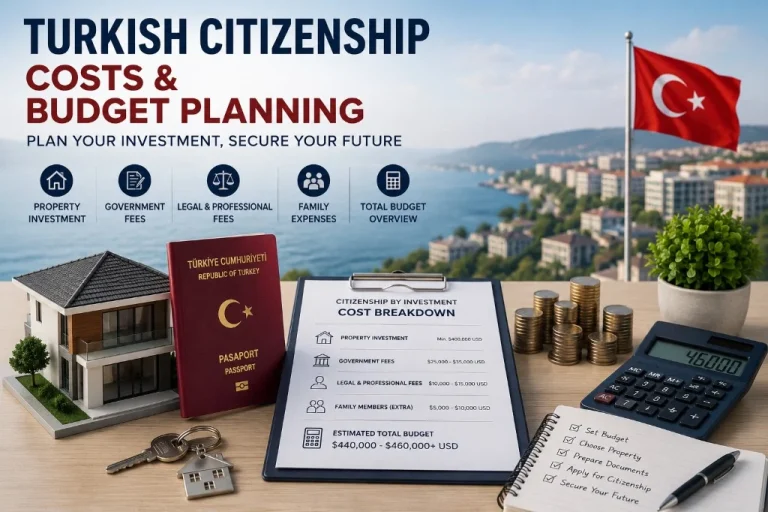
Before you wire a reservation deposit, one question should guide your planning: how much money should I realistically prepare — not just for the property, but for the whole citizenship file? This handbook is the canonical citizenship budget guide. For qualification rules see the Eligibility handbook; for stage sequence see the Timeline handbook; for the program overview see Turkish Citizenship by Investment.
Turkish citizenship consultation guides · Step 3 of 5 — Costs · Next → Family · Timeline
Budget at a Glance — How Much Should I Prepare?
How much do I need in total? Think in layers, not isolated fees. Most property-route buyers budget in this order:
Property budget          USD 400,000+ official valuation (investment floor)
        ↓
Purchase costs           TAPU · registry · DAB · valuation · translation at closing
        ↓
Professional costs       Lawyer · POA · interpreter (if needed)
        ↓
Government costs         Residence · citizenship filing · ID · passport
        ↓
Contingency              Bank charges · FX · admin buffer · reappraisal risk
Indicative total: For a typical resale citizenship purchase, experienced buyers often plan roughly 6–10% above the property price for purchase closing costs alone, then add professional fees, government filing charges, and a contingency buffer. That means someone with USD 435,000 total cash may be tight once USD 400,000+ is committed to qualifying property value — many families plan USD 450,000–500,000+ total liquidity for a comfortable margin. Figures vary by property, family size, and tariffs; confirm case-specific amounts before you commit.
When each layer is paid → Timeline handbook · Line-item fee depth → property purchase costs in Turkey
Is USD 400,000 Enough?
Is USD 400,000 all the money I need? No. USD 400,000 is the qualifying investment floor on official valuation for the property route — not your total cash requirement. You must still budget for purchase closing costs, professional fees, government filing charges, and contingency. Additional transaction and professional costs almost always apply on top of the property itself.
If your total available funds are close to USD 400,000 — for example USD 435,000 — you should immediately map which layer each expense falls into: property value, closing, legal work, government fees, and buffer. Underestimating the stack is one of the most common reasons buyers feel financially surprised mid-file. Qualification rules: Eligibility handbook.
Property Budget Layer
What is the minimum I must invest in property? The citizenship property route requires qualifying real estate whose official appraised value reaches at least USD 400,000 — not the marketing price alone. That amount is registered in your personal name with the three-year no-resale annotation. It is the largest single budget line and the only portion that counts toward the program threshold.
Mandatory vs optional: Mandatory — qualifying property at official value. Optional at this layer — none; this is the investment core.
Variable amounts: Contract price may exceed USD 400,000 while official valuation must still meet the threshold. Multi-property portfolios combine official values — see Eligibility.
Purchase Costs Layer
What do I pay to complete the purchase beyond the property price? This layer covers everything required to transfer ownership and satisfy registry compliance — typically the second-largest budget block after the property itself.
What belongs here (stable concepts):
- Title deed transfer tax (tapu harcı) — statutory transfer charge at registry
- Land registry service fees (döner sermaye) — including foreign-buyer surcharges where applicable
- SPK citizenship valuation / TTB — mandatory for the property route
- Foreign Exchange Purchase Certificate (DAB) — bank conversion charges, not a separate state fee
- Sworn translation at tapu — if you do not speak Turkish at the appointment
- DASK earthquake insurance — compulsory for transfer and utilities
Typical budget band: Most resale buyers plan roughly 6–10% of the property price for closing — tapu tax, registry charges, valuation, notary-related work at closing, and bank FX. Exact amounts depend on declared value, 2026 TKGM and tax schedules, and property type.
Variable amounts → Current tariffs and tables: property purchase costs · TAPU guide · SPK valuation guide · DAB guide
Professional Costs Layer
What should I budget for lawyers, POA, and document work? None of these are legally mandatory for every buyer — but most citizenship-intended purchases use at least some professional support because errors are far costlier than fees.
What belongs here:
- Property lawyer / due diligence — contract and title review before you pay
- Power of attorney — if buying or filing remotely
- Notary fees — passport certification, POA, contracts
- Sworn translation of foreign civil documents — birth, marriage, police clearance *(process → Documents handbook)*
- Interpreter at tapu — if required on transfer day
Typical budget band: Negotiable — often a fixed legal package or a percentage of property price for due diligence. Notary and translation scale with document volume. Amounts depend on firm, city, and case complexity.
Variable amounts → lawyer services in Turkey · POA guide · notary procedures
Government Costs Layer
What do residence, citizenship filing, and passport cost? After purchase, government charges apply for the investor residence track, citizenship submission, and post-approval identity documents. These are separate from tapu transfer tax.
What belongs here (stable concepts):
- Investor residence permit — application and card fees
- Citizenship application — population and citizenship administration charges
- Turkish ID card and passport — after presidential decree
- Health insurance — typically required for the residence file period
Typical budget band: Government fee schedules change. Budget a dedicated line for each applicant in the family file — spouse and children add charges. Confirm current tariffs when you file; do not rely on outdated blog figures.
Variable amounts → Document checklist context: Documents handbook · post-approval outcome: Turkish passport benefits
Contingency Layer — Safety Buffer
What buffer should I keep? Even a well-structured file encounters variables: bank FX spreads, an expired TTB requiring reappraisal, extra translation after a name query, or travel for biometrics. A contingency layer prevents a manageable surprise from becoming a cash-flow crisis.
What belongs here:
- Bank conversion spread beyond headline FX rate
- Re-ordering valuation if TTB validity window expires
- Additional sworn translations after authority queries
- Short visit costs for biometrics *(timing → Timeline Stage 7)*
- Exchange-rate movement between planning and payment
Practical rule: If your total liquidity is only slightly above USD 400,000 — for example USD 435,000 — treat contingency as mandatory, not optional. Most experienced buyers keep a visible buffer after all layers are mapped.
Stage 1 — Decision Costs
What should I budget before I commit? Minimal direct spend — mostly your time and optional early legal consultation. The important budget action is mapping total liquidity across all five layers before you reserve a unit.
Budget layers: Property · Contingency (planning) · Timeline → Stage 1 — Decision
Stage 2 — Reservation Costs
What does holding a unit cost? Developers often take a reservation or holding deposit. Treat this as part of your property budget — it may be non-refundable if you withdraw. Do not pay a deposit before you have mapped closing and professional layers.
Budget layers: Property (deposit) · Timeline → Stage 2 — Reservation
Stage 3 — Eligibility Review Costs
What does pre-purchase verification cost? Optional lawyer review of tapu extract and contract before major payment. Early SPK readiness checks may be advised — full citizenship valuation is usually ordered closer to purchase. Qualification rules, not fees: Eligibility handbook.
Budget layers: Professional (optional) · Timeline → Stage 3 — Eligibility
Stage 4 — Payment Costs
What should I budget when I pay and open banking? This stage concentrates purchase-layer and contingency items tied to moving money correctly.
Budget layers: Purchase · Professional · Contingency
Mandatory: Turkish bank account setup · documented transfer · DAB-related bank conversion charges · foreign tax number (VKN) — usually low or free
Typical band: Bank FX/conversion often ~0.1–0.2% of converted amount; no separate state DAB fee. Budget alongside lawyer review if funds are moving for the first time.
Variable amounts → bank account, tax number & DAB guide · Timeline → Stage 4 — Payment
Stage 5 — TAPU Costs
What do I pay on transfer day? The largest purchase-layer charges usually hit here — transfer tax, registry fees, DASK, and often sworn translation at the registry.
Budget layers: Purchase · Professional · Contingency
Mandatory: Tapu harcı (transfer tax) · döner sermaye registry charges · foreign-buyer surcharge where applicable · DASK · citizenship-purpose valuation if not already paid · tapu interpreter if needed
Typical band: Often the core of the 6–10% closing estimate on property price, plus valuation and DASK. Declared value drives transfer tax — under-declaring creates compliance risk for citizenship files.
Variable amounts → TAPU guide · property purchase costs · Timeline → Stage 5 — TAPU
Stage 6 — Conformity & Valuation Costs
What does SPK valuation and conformity cost? Citizenship files require WebTapu / GEDAŞ valuation producing a TTB confirming qualifying value. If ordered before tapu, this may already sit in Stage 5; if TTB expires under the six-month window, reappraisal adds contingency cost.
Budget layers: Purchase · Contingency
Mandatory: Citizenship-purpose SPK valuation / TTB — fee scales with property size and type per annual SPK tariff
Typical band: 2026 minimum tariffs apply for typical residential units; larger or commercial assets cost more. Amount depends on current official SPK schedule — confirm before you order.
Variable amounts → SPK valuation guide · Timeline → Stage 6 — Conformity
Stage 7 — Residence Costs
What should I budget for the biometrics visit and investor residence? Government filing fees, health insurance for the residence period, and travel for the in-person visit.
Budget layers: Government · Professional · Contingency (travel)
Mandatory: Investor residence application fees · health insurance · biometrics visit costs
Variable amounts: Per-applicant government tariffs — confirm at filing. Timeline → Stage 7 — Residence · Documents → Documents handbook
Stage 8 — Citizenship Application Costs
What does submitting the citizenship file cost? Government application charges plus any remaining translation or notary work to complete the file. Family members on the same application add fees.
Budget layers: Government · Professional (translations)
Variable amounts: Confirm current population and citizenship administration tariffs when you file. Timeline → Stage 8 — Application
Stage 9 — Approval Costs
Are there costs while waiting for the decree? Usually no major new fees — but keep residence permit and any document validity current; renewal or re-translation creates contingency spend if ignored.
Timeline → Stage 9 — Approval
Stage 10 — Passport & ID Costs
What should I budget after citizenship is granted? Turkish identity card and passport application fees — often collectable via consulate abroad without another full trip to Turkey.
Budget layers: Government
Variable amounts: Confirm current ID and passport tariffs at application. Timeline → Stage 10 — Passport · Outcome → passport benefits
What Does Not Count Toward USD 400,000?
Lawyer fees, tapu transfer tax, translation, residence fees, citizenship filing charges, and bank conversion costs do not count toward the qualifying investment threshold. Only your equity in qualifying property — by documented transfer — counts. Borrowed funds do not count. Full rules: Eligibility handbook.
Multi-Property Budgets
Combining two or more properties to reach USD 400,000 official value means multiple purchase-layer stacks — separate tapu charges, valuations, and registry fees per unit — while still one citizenship application. Plan each property’s closing costs, not only the combined threshold. Eligibility — combining properties.
Hidden Costs & Budget Mistakes
Turkish citizenship hidden costs are rarely secret fees — they are costs buyers forget to stack: foreign-buyer registry surcharge, full 4% tapu assignment in contract, reappraisal if TTB expires, family-file government fees, DASK and utilities setup, and under-declaring tapu value to save tax *(which breaks citizenship consistency)*. Treating USD 400,000 as your only budget line is the most expensive mistake.
- Assuming contract price equals total budget — closing and professional layers are separate
- Forgetting valuation is mandatory — not optional for citizenship
- Ignoring foreign-buyer registry surcharge — part of purchase layer
- No contingency when liquidity is tight — USD 435,000 total is often insufficient once layers are mapped
- Counting lawyer or tax fees toward USD 400,000 — they do not qualify
Costly structuring errors that lead to rejection: Rejection Prevention handbook.
After You Own — Ongoing Costs
Citizenship file budget ends at passport issuance for most buyers; ownership continues with annual property tax, DASK renewal, aidat in managed complexes, and utilities. Not part of the citizenship application budget — but part of long-term affordability. Pointer: property purchase costs · annual property tax in Turkey.
Ready to Map Your Budget?
Every file differs — but the five layers and Timeline stage map above are how most property-route families plan total liquidity. If you want a case-specific outline against your shortlist and family structure, our team can help you map property, closing, professional, and government layers without guaranteeing outcomes or fixed totals.
Contact Maximos Real Estate — we have guided more than 500 international families through citizenship-intended purchases since 2005. We do not quote immutable totals; we help you prepare realistically.
Next in your consultation path → Family handbook · Rejection Prevention · Eligibility · Program overview


